“Visual learner? Hands-on problem solver? Knowing the difference transforms mentorship outcomes from average to extraordinary.”
Have you ever mentored someone and felt like your advice wasn’t landing? You shared great insights—but they struggled to apply them.
It’s not about the advice itself. It’s about how it’s delivered.
Great mentorship isn’t just about passing on knowledge—it’s about making that knowledge stick. And that happens when you align your mentorship approach with how your mentee learns best.
Learning styles aren’t just a classroom concept—they apply across careers, generations, and professional roles. Adapting to them is a mentorship skill that builds connection, accelerates progress, and creates lasting change.
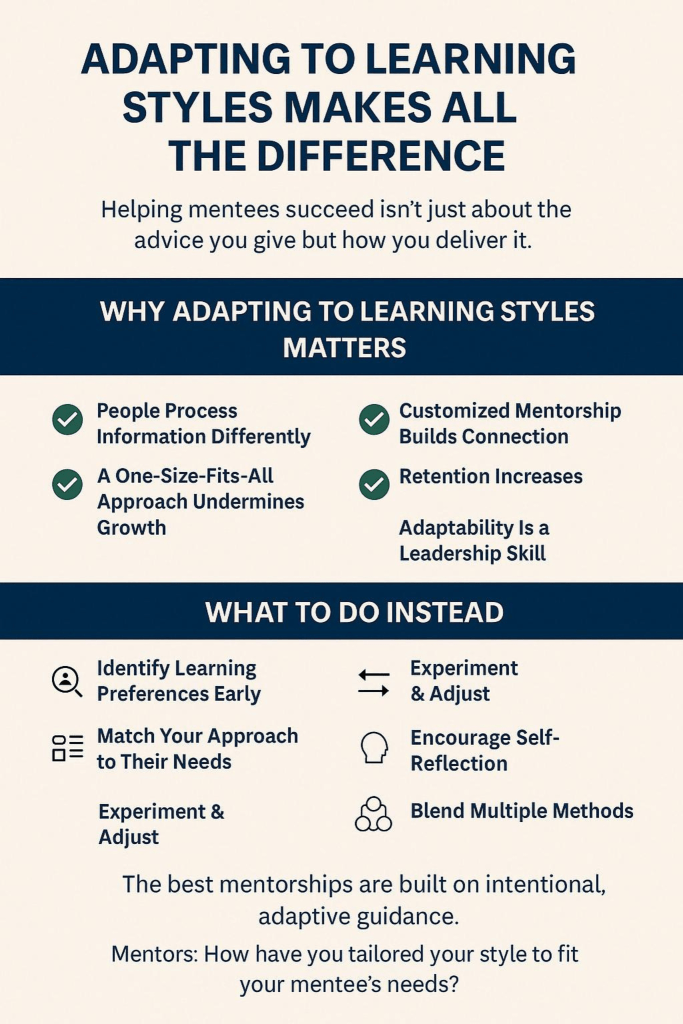
Why Adapting to Learning Styles Matters:
✅ People Process Information Differently
According to Fleming & Mills’ VARK model (1987), individuals learn through different modalities: Visual, Auditory, Reading/Writing, and Kinesthetic. Ignoring these preferences can make even the best guidance feel confusing or irrelevant.
✅ A One-Size-Fits-All Approach Undermines Growth
If you only mentor the way you prefer to learn, you risk disengaging your mentee. What excites you may overwhelm them—or vice versa.
✅ Customized Mentorship Builds Connection and Confidence
When mentees feel like you “get them,” their confidence and engagement skyrocket. Tailored guidance shows respect, builds trust, and leads to faster results.
✅ Retention Increases
Learning that matches personal preferences improves information retention (Brusilovsky & Millán, 2007). That means mentees are more likely to apply what they learn long-term.
✅ Adaptability Is a Leadership Skill
Great mentors don’t just share what they know—they flex how they teach. This ability to pivot is a hallmark of emotional intelligence and leadership maturity.
What to do instead:
🔹 Identify Learning Preferences Early
Ask open-ended questions like:
“Do you like visual explanations, hands-on examples, or deep conversations?”
Use tools like VARK questionnaires (free online) or simple trial-and-error observations.
🔹 Match Your Approach to Their Needs
- Visual learners? Use charts, infographics, diagrams, or shared slides.
- Auditory learners? Focus on stories, podcasts, and verbal feedback.
- Kinesthetic learners? Set up simulations, case studies, or real-world projects.
- Reading/Writing learners? Provide articles, reflective journaling prompts, or summaries.
🔹 Experiment & Adjust
If your mentee isn’t making progress, change it up. Are they zoning out during Zoom calls? Maybe switch to written follow-ups. Are written notes getting ignored? Try Loom videos.
🔹 Encourage Self-Reflection
Prompt mentees to reflect on how they absorb and apply information. Ask:
“What type of learning moment has stuck with you the most so far?”
🔹 Blend Multiple Methods
Most people are multi-modal learners. Rotate formats to engage all senses and keep things dynamic. Example: Start with a case study (reading), debrief with a discussion (auditory), and assign an action (kinesthetic).
example in action:
Maya, a marketing manager, was mentoring Liam, a data analyst. Early on, Maya sent detailed written summaries after each session. Liam appreciated the effort—but wasn’t retaining much.
After a conversation about learning preferences, Liam shared that he understands best through visuals and real-world tasks. Maya pivoted. She used Miro boards to visualize marketing funnels, and assigned small data-cleaning challenges linked to campaign goals.
Liam’s engagement soared—and he began proactively applying insights between sessions. Maya, in turn, became more confident in mentoring people outside her domain.
why it matters:
Tailoring mentorship to learning styles isn’t extra work—it’s essential for meaningful impact.
In a diverse, fast-paced world, personalization is the key to deeper learning, stronger trust, and better outcomes.
summary:
The best mentorships aren’t built on generic advice. They’re built on intentional, adaptive guidance that honors how people learn.
Mentors who master this become catalysts for growth—faster, deeper, and more sustainable.
💬 Mentors: How have you tailored your style to fit your mentee’s needs? Share what’s worked—and what you’ve learned.
#Mentorship #LearningStyles #AdaptiveLeadership #GrowthMindset #CoachingSkills #ProfessionalDevelopment #MentorTips #TransformationalMentorship
 Mentorship Navigator
Leave a comment