
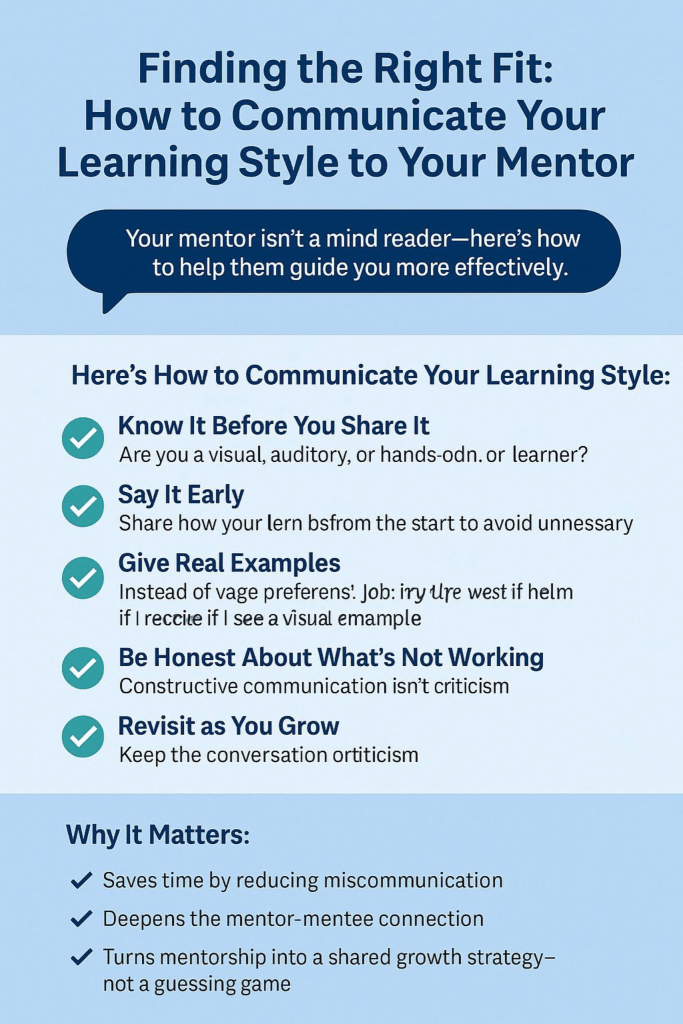
“Your mentor isn’t a mind reader—here’s how to help them guide you more effectively.”
introduction:
The most successful mentorships don’t happen by chance—they are built intentionally through clear, ongoing communication.
One critical, often overlooked factor? Learning styles.
If your mentor doesn’t understand how you best absorb and apply information, even the most brilliant advice can fall flat. According to Fleming and Mills’ VARK model (1992), individuals typically have dominant learning preferences: Visual, Auditory, Reading/Writing, or Kinesthetic.
It’s not your mentor’s job to guess your style. It’s your responsibility to communicate it.
Here’s how to bridge the gap and turn mentorship into a powerful, personalized growth experience.
How to Communicate Your Learning Style to Your Mentor:
✅ Know It Before You Share It
Before any meaningful mentorship exchange can happen, you must understand yourself.
- Are you a visual learner who benefits from diagrams and mind maps?
- An auditory learner who processes best through conversation and verbal explanation?
- A kinesthetic learner who needs hands-on examples and experiential activities?
Take a free VARK questionnaire or reflect on past learning experiences to pinpoint your dominant style (Fleming, 1992).
✅ Say It Early
Proactive communication prevents friction later. Early in the mentorship relationship, clearly state your preferences.
Example:
“I tend to retain information better when I can visually map it out—do you mind if we incorporate some charts or diagrams during our sessions?”
Setting expectations upfront eliminates second-guessing and saves time.
✅ Give Real Examples
Avoid general statements like “I’m a visual learner.” Instead, provide specific insights into what works for you.
Example:
“During my last training, seeing a workflow diagram made the concept click instantly. A similar approach could really help me here.”
Specificity empowers your mentor to tailor their advice to match your needs.
✅ Be Honest About What’s Not Working
If you find yourself struggling to connect with the guidance offered, say something—early and respectfully.
Constructive feedback strengthens relationships, and being honest about learning barriers is a sign of self-awareness, not criticism.
✅ Revisit as You Grow
Your learning preferences may evolve as you gain more skills and experience. What worked at the start may not work six months in.
Keep the lines of communication open:
“I’ve noticed lately that hands-on examples are helping me apply what we discuss even more effectively.”
Self-reflection is a critical tool for sustaining an impactful mentorship relationship (Kolb’s Experiential Learning Theory, 1984).
why it matters:
✔️ Saves Time by Reducing Miscommunication
Understanding and aligning learning styles from the beginning prevents misunderstandings that waste time and slow down progress.
✔️ Deepens the Mentor-Mentee Connection
Effective communication builds trust and mutual respect, creating a more authentic and dynamic relationship.
✔️ Turns Mentorship into a Shared Growth Strategy
When both mentor and mentee are actively invested in adapting communication and learning methods, mentorship shifts from one-sided to co-created.
✔️ Maximizes the Impact of Every Session
By tailoring delivery, mentors ensure that knowledge sticks and mentees apply insights faster and more confidently.
summary:
Mentorship works best when you lead with clarity. When you articulate how you learn, you empower your mentor to meet you where you are—and accelerate your personal and professional growth.
Don’t leave your mentorship experience to chance. Take charge of how you learn best, and help your mentor help you succeed.
👉 Follow our page for more practical mentorship insights that drive real results.
#Mentorship #MenteeSuccess #LearningStyles #ProfessionalGrowth #MentorTips #EffectiveCommunication #LeadershipDevelopment #CareerClarity
Checklist: How to Communicate Your Learning Style to Your Mentor:
Step 1: Identify Your Learning Style
- Complete a VARK or similar learning style assessment.
- Reflect on past learning experiences: What formats helped you absorb information fastest?
Step 2: Communicate It Early
- During your initial mentorship meetings, state your preferred learning style clearly.
- Example: “I retain information best when I can visualize it—diagrams really help me.”
Step 3: Give Specific Examples
- Share real-life examples of how you’ve learned effectively before.
- Suggest formats your mentor can easily integrate (visual aids, storytelling, hands-on practice).
Step 4: Speak Up If It’s Not Working
- If advice feels unclear, respectfully ask for an alternative explanation.
- Example: “Could we walk through a visual example? That usually helps me apply the idea better.”
Step 5: Reassess and Adapt Over Time
- Periodically review what’s working.
- Stay open to evolving your style as you gain new skills or encounter new challenges.
tip:
Communicating your learning preferences isn’t demanding—it’s leading. Great mentees help mentors deliver real impact.
 Mentorship Navigator
Leave a comment